
Skip to content
About

I find where AI makes you untouchable. Then I build it.

Twenty years and $350M+ of enterprise software shipped at Oracle, SAP, Adobe, Microsoft, Google, and AWS. Not a consultant. Not a developer. The architect who designs the system and builds it.
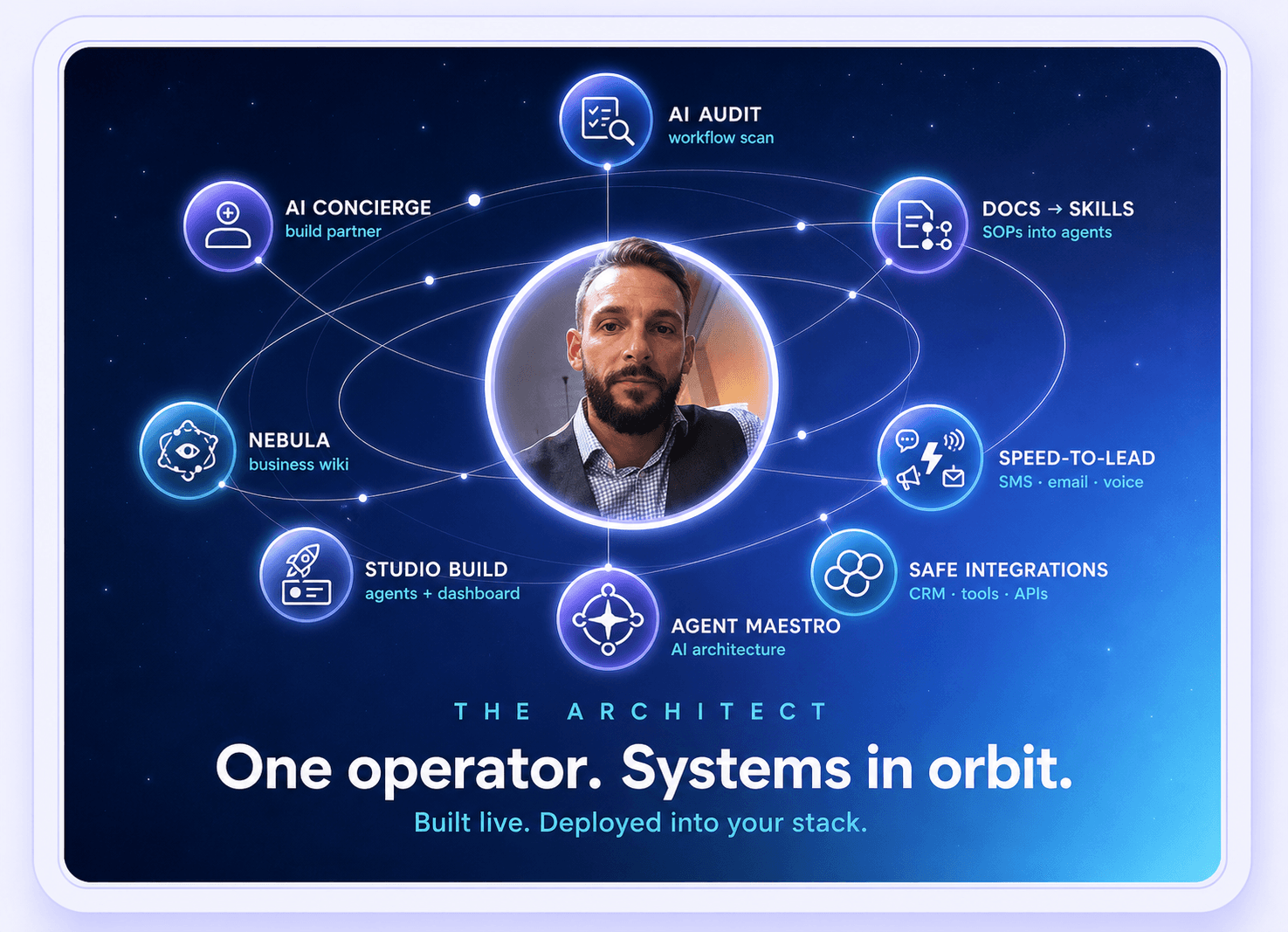
The Architect — Jonathan at center with Imagine AI systems in orbit: AI Audit, AI Concierge, Nebula, Studio Build, Agent Maestro, Docs to Skills, Speed-to-Lead, and Safe Integrations. One operator. Systems in orbit.
Why hire me

I've built the patterns at hyperscale — and I still write the code.

Most AI consultants have half the job: they sell the vision, or they build the tool. I've spent two decades doing both — $350M+ architected and closed across every data and AI wave, a $10M agentic AI engagement delivered at a top-10 U.S. bank, and now Imagine AI built and run by me directly.

$350M+ architected and closed
Two decades from first call to signed deal.
Storage, databases, BI, analytics, ML, GenAI, agentic AI — sold and architected through every wave at Oracle, SAP, Adobe, Microsoft, Google, and AWS. You're not paying me to learn the patterns; you're paying me to apply them.
Scale patterns that hold
Architected ALO Yoga’s AWS scale pattern.
I architected the AWS pattern that scaled ALO Yoga from a nine-figure business into the much larger operation it became. Pick the architecture before the growth, not after.
$10M agentic AI at a top-10 bank
Enterprise-grade, delivered hands-on.
A $10M agentic AI engagement delivered at a top-10 U.S. bank — the same hands and the same standard you get here. Regulated, audited, in production.
Builder, not just advisor
Imagine AI is built and run by me directly.
A multi-tenant platform on Next.js, Supabase, Anthropic, Twilio, SendGrid, and Vercel. Tenant-scoped agents, server-side compliance gates. The person who built it is the person you'll work with.

You're not hiring a consultant to study your business. You're hiring the person who can diagnose the workflow, design the system, and ship it.

The story

Why I left the enterprise seat.

2005 — 2024
Enterprise architecture, built for delivery.

I spent two decades inside enterprise technology, working with many of the hyperscalers and shaping complex software initiatives at scale. Over time I moved deeper into architecture, because the only question that mattered was whether the system could actually be designed, deployed, adopted, and made valuable in the real world.

As a consultant I saw the same pattern repeat: oversized teams, inflated scopes, long timelines, and ambitious AI programs that rarely made it to production. The market became very good at talking about it, and very bad at shipping it.

I learned what separates the few successful projects from the many expensive misses: clear architecture, disciplined scope, direct accountability, and a path to production from day one. When I lead the design, those are the conditions I create.

Imagine AI exists to bring that model to clients directly: senior architecture, direct execution, and production-grade AI systems without the layers, delay, and waste that usually kill momentum.

The alternative

The alternative to Imagine AI.

Three options most mid-market operators evaluate. Here's how they stack up against a build with me.

Option A
Big-firm consultancy
McKinsey / Deloitte / BCG
Strategy deck, stakeholder map, framework
No deployed system
Junior team builds, partner sells
$500K–$2M over 6–18 months
6–18 months · partner-led
Option B
Full-time VP of AI
$400–600K+ / yr
Someone on the org chart
6–9 months to hire
One hire can't build a full system alone
$500K+ all-in · $2M with a team
6–9 months to hire
Option C
Imagine AI
scope to fit · book a call
Deployed system, live in days
Agents + living Nebula + dashboard
One architect, direct access, ongoing support
Flat pricing, everything included
Days · architect-led
How I operate

Nobody operates like this. That's the whole point.

A one-person practice that ships like a team — because the operating system underneath it is engineered as carefully as anything I build for a client.

Global operating setup
Claude, configured to my standards.
A global behavioral standard every agent inherits — how I write, review, and ship, encoded once and applied everywhere.
Gated loop harness
Autonomous build, approved from my phone.
Agents run long build loops on their own and pause at gates for remote approval — I unblock a run from anywhere.
Self-improving loops
Persistent memory and feedback.
Every run feeds the next: durable memory plus structured feedback, so the system gets sharper on my work over time.
Nebula knowledge engine
Everything reasons over one brain.
A compiled, self-healing knowledge base every agent reads from — source-cited by default, so decisions trace to ground truth.
Codex push gate
Adversarial review to convergence.
Nothing merges until an adversarial review runs against it and converges. The code argues with itself before production.
Token & budget management
Compute spent where it pays.
Active budget control across runs — context and spend allocated deliberately, so the expensive thinking lands on hard problems.
Multi-agent fan-out
Parallel work, one owner.
Work fans out across multiple agents in parallel and converges back to me — team throughput, one architect accountable.
Worktree isolation
Parallel streams never collide.
Each stream of work runs in an isolated worktree, so concurrent builds stay clean and nothing steps on anything else.
Pre-ship readiness gate
It survives Monday morning.
A final readiness gate before anything ships — if it can't handle real users, edge cases, and an unwatched weekend, it doesn't go out.
Principles

How I work — six rules I don't break.

01
The architect is the product.
Twenty years shipping enterprise software. You're hiring me, not a pod. I'm on every call, I write the architecture, I deploy the system.
02
Flat prices, everything included.
No add-on modules, no discovery-phase upsells, no "phase two" surprise. If the scope changes mid-build, I absorb it.
03
Speed is a feature.
Live in days, not six months. Every day a system isn't in production is a day it's not earning.
04
Production, not demo.
Real systems with real users — not slide-deck POCs. Code that runs on weekends, handles edge cases, stays up when nobody is watching.
05
Simplicity first, advanced inside.
Minimum code that solves the problem. No speculative abstractions. The techniques inside are genuinely advanced.
06
Secure, compliant, no shortcuts.
TCPA, GDPR, SOC 2 patterns baked in from day one. Auth on every surface, secrets out of the repo, audit trails where they belong.
Let's talk

The best way to see what I do is to get on a call.

I'll ask you three questions. You'll know in 20 minutes whether Imagine AI fits.